Norway at a glance
| Best months | December to March for snow and Northern Lights; February and March offer more daylight while retaining strong northern and mountain conditions |
| Typical winter temperatures | Approximately 0 to -15°C in leading northern areas: exposed coasts often sit around 0 to -7°C, while inland Finnmark commonly averages about -10 to -15°C in January and February |
| Currency | Norwegian krone (NOK) |
| Approximate seven-day ground budget | NOK 3,700–9,000 (approx. £290–£710) per person, excluding international flights |
| Winter Experience Score | 8.4/10: snow 8.5, nature and wilderness 9.5, winter experiences 9.5, uniqueness 9, value 5.5 |
| Best for | Northern Lights, fjords, Arctic mountain scenery, ski touring, dog or reindeer sledding and winter wildlife |
| Main winter destinations | Tromso, Lofoten Islands, Alta and inland Finnmark, Svalbard and Lyngen Alps |
Norway's coastal and inland climates differ materially. Latitude alone does not describe the trip: exposed coast can be relatively moderate, while inland Finnmark is much colder.
Why visit Norway in winter?
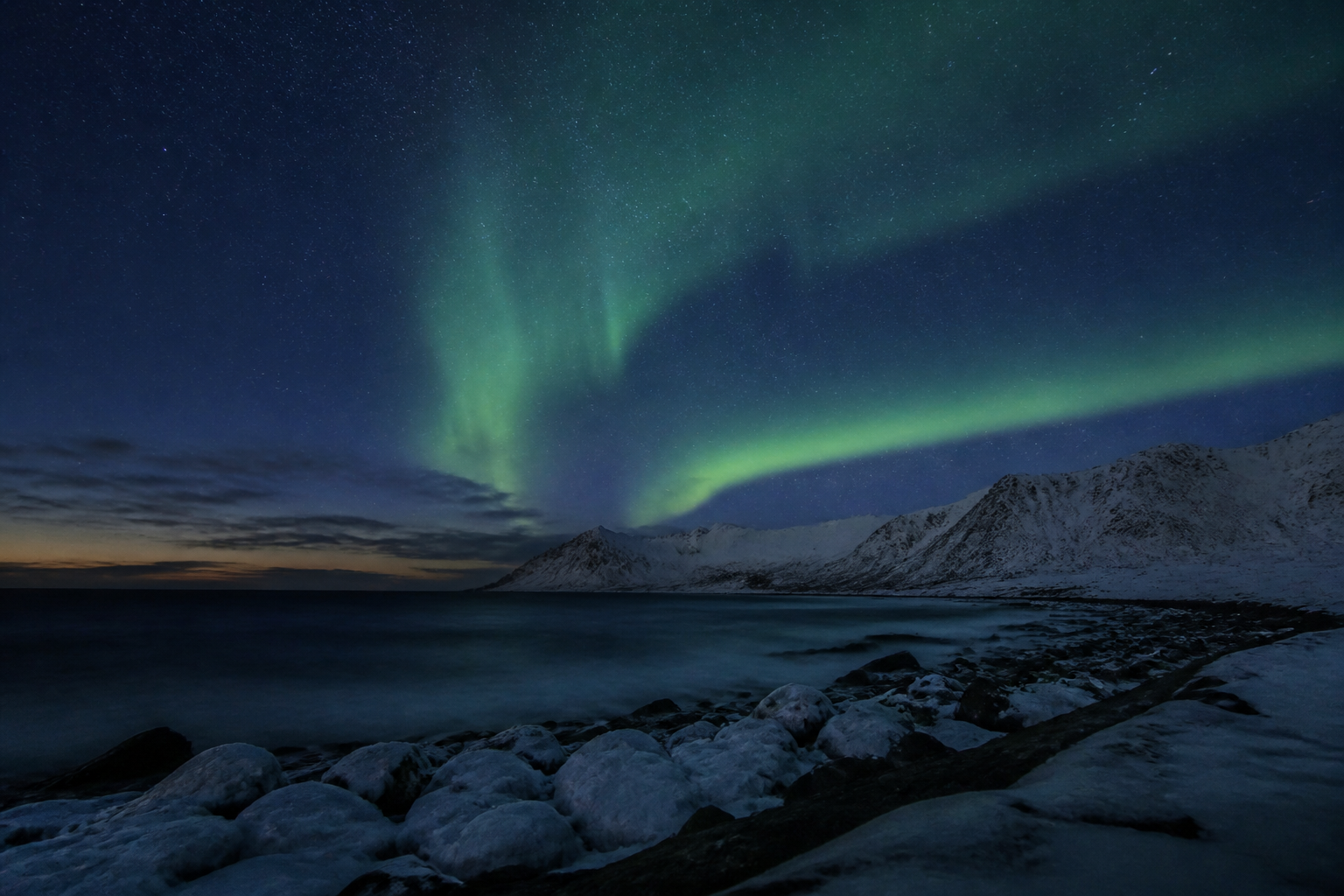
Norway's defining winter image is a snowy mountain rising beside a fjord or open sea. That coastal-mountain relationship separates it from forest-led Lapland and gives northern destinations a strong visual identity. Lofoten and Lyngen are particularly important to this combination, while Tromso provides a practical base for accessing a wider activity programme.
Aurora are another major strength. Northern Norway lies beneath the auroral oval and receives the maximum 10/10 component score for pure aurora potential in the Northern Lights comparison. The complete ranking places Norway second rather than first because it also considers value, supporting activities, setting and uniqueness. Even so, the country offers one of the most established ways to build a winter trip around professionally run aurora outings.
The holiday does not need to depend entirely on the lights. Dog sledding, reindeer experiences, cross-country skiing, ski touring, snowshoeing, fjord cruises, seasonal wildlife and Sami cultural activities create credible daytime plans. This matters because cloud can obscure an otherwise active aurora, and a rewarding itinerary should remain worthwhile without a guaranteed display.
The coastal climate is part of Norway's character rather than a simple weakness. Temperatures can be less severe than latitude suggests, making some northern bases more approachable than inland Arctic alternatives. The same maritime influence brings cloud, wind and rapidly changing snow, so travellers exchange extreme continental cold for greater day-to-day variability.
Principal strengths: exceptional aurora potential; a distinctive fjord, coast and mountain setting; mature guiding and tourism infrastructure; broad Arctic activities; and relatively moderate coastal temperatures for the latitude.
Principal trade-offs: accommodation, food and guided activities are costly; polar night limits daylight in the far north; coastal conditions change quickly; and the leading regions require separate journeys or transfers.
Best winter destinations in Norway
These summaries describe the best use of the five destinations already identified in the country record. They do not add unsupported local prices, detailed routes or destination-specific temperature claims.
Tromso
Tromso is Norway's strongest all-round Arctic base. It combines established aurora guiding with dog sledding, reindeer activities, snowshoeing, winter cruises and access to snowy coastal landscapes. It is best for a first northern Norway trip in which travellers want several organised options rather than one specialist objective.
Traveller reports often praise well-run aurora chases, accessible public transport and the fact that other activities can keep the trip rewarding when the lights are weak. High prices, clouds, late tour returns and occasional cancellations are the repeated drawbacks.
Lofoten Islands
Lofoten is the principal choice for winter coastal scenery. Sharp mountains, islands, sea and settlements create the visual combination that makes Norway distinctive in the photography ranking. It is best for landscape-led travel, low winter light and travellers who value atmosphere as much as a packed activity schedule.
Fast-changing coastal weather is central to the experience and the planning risk. Lofoten should not be treated as having the same cold or snow consistency as inland Finnmark, even though both belong to northern Norway.
Alta and inland Finnmark
Alta and inland Finnmark provide a colder, more continental Arctic alternative to the exposed coast. The region is relevant for aurora, dog or reindeer sledding, Sami cultural experiences and broad snowy landscapes. It is best for travellers who want a strong Arctic setting without making coastal fjords the only visual focus.
Inland conditions can be considerably colder than Tromso or Lofoten. The benefit is a more emphatic deep-winter environment; the compromise is the need for clothing and activity planning suited to lower temperatures.
Svalbard
Svalbard supplies Norway's clearest high-Arctic identity. It is the best-use choice for travellers prioritising polar landscapes, wilderness atmosphere and seasonally appropriate wildlife experiences. Its inclusion strengthens Norway's scores for uniqueness, adventure and photography.
Svalbard is a specialist trip rather than a routine extension of every Tromso itinerary. Activities, daylight and wildlife relevance depend on season, and guided programmes can move costs well beyond the general national benchmark.
Lyngen Alps
The Lyngen Alps are Norway's specialist ski-touring and mountain-adventure destination in this guide. Their central appeal is steep snowy terrain above fjords, producing a combination of physical activity and coastal scenery that is hard to match.
Lyngen is best for suitably experienced travellers using appropriate professional support, not as a casual independent day trip. Coastal weather and mountain conditions require flexible objectives even within the core winter season.
Best winter experiences
- Chase the Northern Lights: Northern Norway offers excellent aurora potential, but guides, mobility and multiple nights improve a plan without creating a guarantee.
- Ski tour above the fjords: Lyngen provides the clearest expression of Norway's mountain-and-sea adventure identity.
- Try dog or reindeer sledding: Tromso, Alta and Finnmark use these activities to add depth to an aurora-focused trip.
- Take a winter fjord cruise: Coast, mountains and low Arctic light can be experienced without making skiing the centre of the holiday.
- Look for seasonal wildlife: Whale and other Arctic wildlife excursions add a nature dimension when seasonally available.
- Explore Sami culture: Cultural experiences help explain the human context of the northern landscapes.
- Snowshoe or cross-country ski: These provide quieter access to winter terrain beyond specialist mountain routes.
When to go
December to March is the broad window for snow, darkness and Northern Lights. December and January provide polar-night atmosphere in far-northern destinations, while February and March offer more usable daylight without losing the core winter setting.
Choose dates around the main purpose of the trip. Aurora need darkness but are never guaranteed; ski touring and wildlife have their own seasonal considerations; and coastal snow or cloud can change rapidly. Inland Finnmark is generally colder than the coast, so the same month can produce very different practical conditions.
For a mixed first trip, later winter usually makes daytime scenery and outdoor activities easier to combine with dark evenings. Midwinter remains the better fit when polar-night atmosphere itself is central to the experience.
Winter costs
The existing seven-day ground benchmark is NOK 3,700–9,000 (approx. £290–£710) per person, excluding international flights. It is a broad budget-to-mid-range national estimate rather than a complete guided Arctic itinerary.
Accommodation, dining, fjord transfers, repeated aurora outings and other guided activities can increase the total materially. Svalbard and specialist Lyngen programmes can be substantially more expensive. This page does not assign separate destination budgets because none have been established in the country record.
Practical UK entry information
British citizens can visit Norway and the wider Schengen area visa-free for up to 90 days in any 180-day period. The passport must have been issued less than 10 years before arrival and expire at least three months after the planned Schengen departure. EES biometric registration may be required.
These formalities are separate from the Winter Experience Score. Check current official UK entry requirements again before travel.
What travellers say
Travellers often praise Tromso and northern Norway for dramatic snow-covered scenery, organised aurora chases, dog sledding and practical local transport. Many report that the wider winter programme made the holiday memorable even when aurora were weak or absent, supporting the case for planning activities beyond night-time viewing.
Recurring complaints are high prices, clouds, fast-changing weather, late returns from aurora tours and occasional cancellations. Those concerns do not weaken the underlying aurora potential, but they do show why a flexible multi-night itinerary is more realistic than a one-evening promise. This summary aggregates existing public discussions without inventing quotations.
Where Norway ranks
Norway ranks second for the complete Northern Lights trip despite holding the highest pure aurora-potential component. It also performs strongly in wilderness, adventure and photography, while value and less consistent coastal snow lower the overall and Snow rankings.
| Ranking | Position | Score |
|---|---|---|
| Winter tourism | #4 | 8.4/10 |
| Snow and a real winter | #5 | 9.0/10 |
| Northern Lights winter trip | #2 | 9.1/10 |
| Winter wilderness | #3 | 9.1/10 |
| Winter adventure | #3 | 9.4/10 |
| Winter photography | #4 | 9.4/10 |
FAQ
Is Norway good for a winter holiday?
Yes. Norway is particularly strong for Northern Lights, fjords, Arctic mountains, ski touring and organised winter activities. It is less suitable for a low-cost trip because food, accommodation and guiding are expensive.
Where is the best place in Norway for a first winter trip?
Tromso is the most versatile base because aurora outings, sledding, cruises and snowy landscapes can be combined in one stay. Choose Lofoten for photography, Alta for inland Arctic conditions, Svalbard for high-Arctic atmosphere or Lyngen for ski touring.
Is Norway the best country for the Northern Lights?
Norway has the highest pure aurora-potential component score, but ranks second in the complete Northern Lights comparison at 9.1/10. The full ranking also evaluates winter setting, supporting experiences, value and uniqueness.
When is the best time to visit northern Norway in winter?
December to March is the main window. February and March are often the best balance for travellers wanting both strong winter conditions and more daylight.
How much does a winter trip to Norway cost?
The broad seven-day ground benchmark is NOK 3,700–9,000 (approx. £290–£710) per person, excluding international flights. Repeated guided activities, remote stays and Svalbard or ski-touring programmes can cost substantially more.
Can I enjoy Norway in winter without skiing?
Yes. Aurora outings, dog or reindeer sledding, fjord cruises, snowshoeing, seasonal wildlife and Sami cultural activities form a substantial non-ski programme. Tromso and Alta are especially relevant for this mix.
What is Norway's main winter drawback?
Cost is the most consistent drawback, followed by cloud and rapidly changing coastal weather. Polar-night darkness and long distances between headline regions also require realistic planning.
Sources & notes
Facts and traveller sentiment were checked on 20 August 2026. This page uses only the existing Norway references:
- Norway entry requirements
- MET Report 02/2026
- Winter in Tromso
- Norway travel costs
- Tromso January trip report
- Norway winter trip report
- Tromso traveller discussion
GBP equivalents are approximate and use exchange rates checked on 20 August 2026. Actual exchange rates may vary.