Altai & Siberia at a glance
| Best months | January to March; December is viable at developed resorts, while February and March offer a better balance of established snow and daylight |
| Typical temperature | Highly variable by elevation and basin: average January conditions range from about -12°C in milder valleys to roughly -32°C in high continental basins such as Kosh-Agach |
| Snow conditions | Strongly uneven: northern and northeastern mountains can hold deep snow, while the Chuya and Kurai steppe basins may be dry, wind-scoured or nearly snowless |
| Aurora relevance | Limited / not a core reason to visit — mountain landscapes and continental winter are the main attractions |
| Approximate five-day ground budget | RUB 35,000–90,000 (approx. £300–£780) per person from Gorno-Altaysk |
| Main gateway | Gorno-Altaysk Airport, followed by road transfers to Manzherok, Lake Teletskoye and more remote areas |
| Best for | Mountain and taiga scenery, skiing, winter road journeys, low-crowd landscapes and regional culture |
Why visit in winter?
Altai offers a combination of developed snow access and much wider mountain landscapes. Manzherok provides the clearest resort base near Gorno-Altaysk, while the Teletskoye area adds another ski and lake setting. The Chuya Highway moves through river valleys towards high steppe and more severe continental environments.
These elements support two different trip styles. A short Manzherok stay emphasises accessible skiing and prepared facilities, whereas Teletskoye or a Chuya Highway journey adds longer transfers and a stronger landscape focus. Combining them is possible only with realistic road time; they should not be described as adjacent attractions within one resort.
The regional contrast is fundamental. Northern and northeastern mountain areas can provide deep snow, while the Chuya and Kurai basins in southeastern Altai may be dry, exposed and nearly snowless. This variation creates distinctive photography and scenery, but it prevents simple claims that every part of the destination has identical powder conditions.
The title combines Altai & Siberia because that is the fixed broad destination entity used across the site. However, the climate figures, gateway, Manzherok, Teletskoye, Chuya Highway, Karakol Valley and travel details on this page relate primarily to the Altai Republic. They must not be treated as a description of all Siberia.
Strengths: varied mountains, taiga, rivers and high-steppe landscapes; clear continental winter; a mix of developed skiing and remote scenery; lower entry-level ground costs than Kamchatka; and regional cultural experiences.
Trade-offs: sharply different snow regimes; long road transfers; severe cold in high basins; and sparse tourist services outside the main resort and road corridors.
Best winter experiences
- Ski or snowboard at Manzherok: The developed area provides the most straightforward winter-sport base near Gorno-Altaysk.
- Use the Teletskoye ski area: Lake and mountain scenery create a second established winter focus.
- Travel the Chuya Highway in winter: The road reveals river valleys, mountains and high continental landscapes with changing snow cover.
- Snowshoe or ski through taiga: Quieter active travel opens forest and mountain settings beyond the main pistes.
- Try dog sledding in the Karakol Valley: This adds a guided winter activity in a regional landscape.
- See the Katun and Chuya valleys: Frozen rivers and open terrain are among the strongest photographic subjects.
- Explore Altai culture and food: Cultural context helps distinguish the trip from a generic ski holiday.
Snow and winter conditions
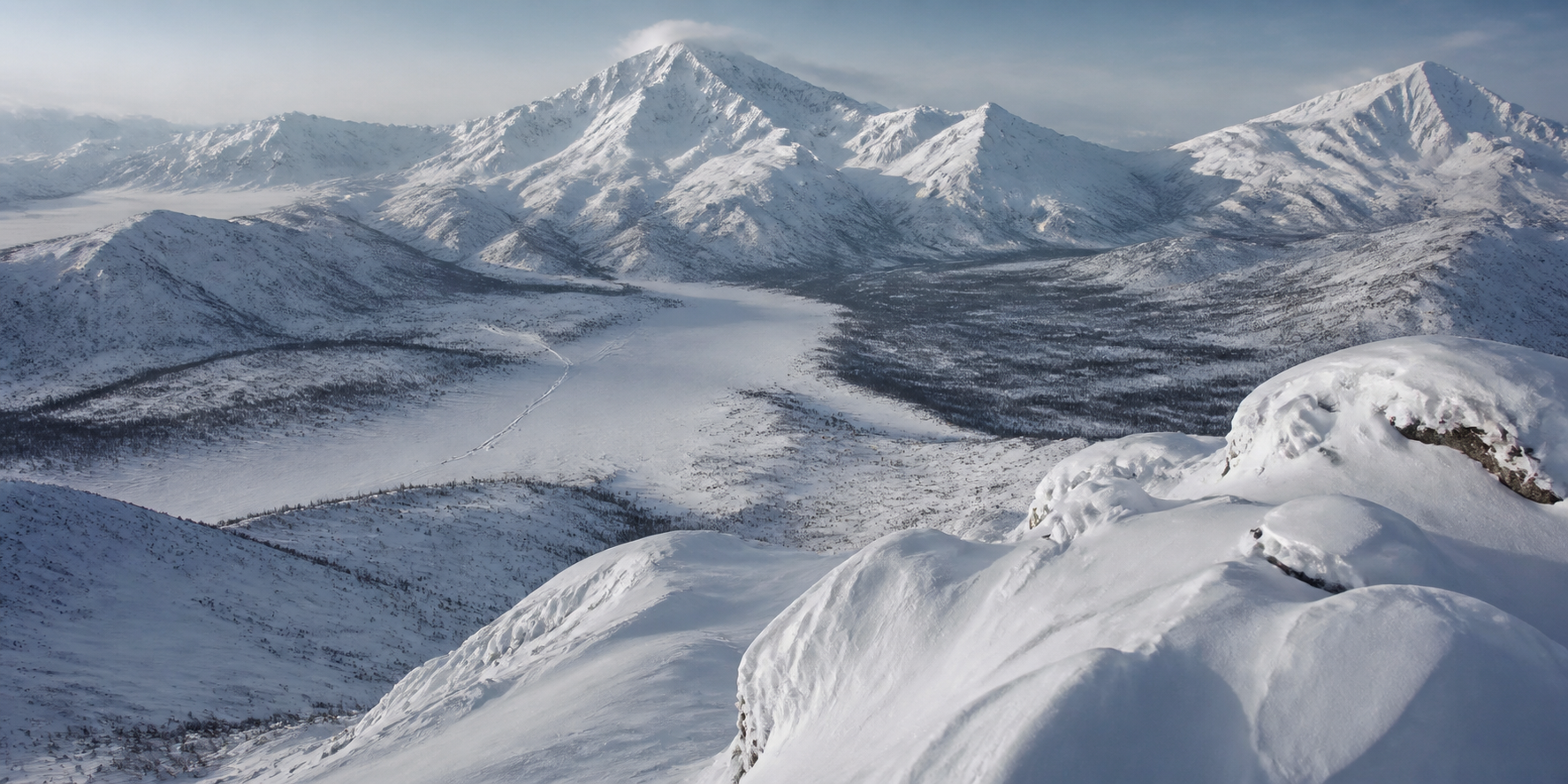
Snow normally establishes from late October or November depending on elevation, but depth and persistence vary strongly. Northern and northeastern slopes and ski zones can hold substantial snow. Southeastern steppe basins are much drier and can be wind-scoured.
Average January conditions range from about -12°C in milder valleys to around -32°C in high basins such as Kosh-Agach. Short-term conditions can be more severe, and cold may stop lift operations or constrain time outdoors.
Elevation and basin shape matter alongside latitude. A snowy ski area does not establish conditions in the southeastern steppe, and a dry-looking high basin does not mean the northern mountains lack snow. This local contrast is one of Altai's defining winter facts and the reason broad Siberia-wide claims are avoided.
Aurora classification is limited / not a core reason to visit. Displays may occur during strong geomagnetic storms, but Altai's main visitor areas lie south of the dependable auroral oval. Winter mountains, continental scenery and outdoor activity are the evidence-supported reasons to choose the destination.
Best time to visit
January to March is the main window. January offers a strong continental-winter experience but may bring severe cold. February and March generally improve the balance of established snow and daylight.
December can work at developed resorts, though conditions across more remote areas should not be assumed from the resort base. The best timing depends on whether skiing, the Chuya Highway, photography or a quieter taiga experience carries the most weight.
Later winter also provides more usable daylight for long road and landscape days.
How to get there
Gorno-Altaysk Airport is the main gateway. Manzherok is about 30 km away by road, making it the closest major winter base in the record. The northern shore of Lake Teletskoye is roughly 250 km away.
The Chuya Highway, Ulagan, Kosh-Agach and other mountain locations require much longer road transfers, normally by a suitable vehicle or organised tour. Distances and service availability mean that a resort stay and a remote road itinerary should be planned as different levels of trip.
Lake Teletskoye also requires a substantial transfer from the airport area. Travellers should choose whether the holiday centres on Manzherok, Teletskoye or a road journey before adding secondary activities, since each option places different demands on time and transport.
Winter costs
The existing five-day ground benchmark is RUB 35,000–90,000 (approx. £300–£780) per person, starting from Gorno-Altaysk. The lower end represents a basic shared resort programme; the upper end allows for more active travel with transfers and guided excursions.
Premium Manzherok accommodation can exceed the range. Longer road journeys and private transport also change the cost, but no unsupported additions are modelled here. The figure excludes international flights and is not a budget for Siberia as a whole.
What travellers say
Travellers praise Altai's quiet winter landscapes, frozen rivers and broad prepared runs around Manzherok. They also value the contrast between developed resort facilities and remote mountain scenery, with relatively low crowd levels appearing as a repeated positive.
The UGC layer is narrower than for Kola or Baikal, so the sentiment is intentionally limited. Recurring issues are severe cold that can stop lifts, local transport needs for remote sights and weak mobile reception away from the main corridor. No broader claims about Siberian winter travel are inferred from these Altai discussions.
The positive comments are therefore most useful as confirmation of quiet scenery and prepared skiing around Manzherok, not as evidence for every remote valley. This distinction keeps the traveller layer aligned with the places actually discussed.
How this destination fits into a Russia winter trip
Choose Altai & Siberia within a Russia winter holiday when mountain roads, continental cold, taiga and a mixture of resort access with remote scenery are the priorities. Choose Kola Peninsula & Murmansk for strong aurora potential; Kamchatka for deeper maritime snow and volcano-led specialist adventure; Lake Baikal for transparent ice; or Karelia for a more accessible forest-and-culture itinerary.
Altai's starting budget can be lower than Kamchatka's, but long road transfers still shape the trip. The five Russian destinations are geographically distant and normally require separate holidays rather than one short circuit.
Relevant comparisons: Best Snow Destinations, Best Winter Wilderness Destinations, Best Winter Adventure Destinations and Best Winter Photography Destinations.
FAQ
Is Altai worth visiting in winter?
Yes, for mountain scenery, continental winter, skiing and quieter road-based travel. It is less suitable for travellers expecting uniform deep snow or dense tourist services across the region.
What are the best months for Altai in winter?
January to March is the main period. February and March generally offer a better balance of established snow and daylight, while January can be substantially colder.
Does all of Altai have deep snow?
No. Northern mountain and ski areas can hold deep snow, while the Chuya and Kurai steppe basins may be dry, wind-scoured or nearly snowless.
How cold is Altai in winter?
Average January conditions range from about -12°C in milder valleys to around -32°C in high continental basins such as Kosh-Agach. Severe spells can affect lifts and outdoor plans.
How much does a five-day Altai winter trip cost?
The benchmark is RUB 35,000–90,000 (approx. £300–£780) per person from Gorno-Altaysk. Premium Manzherok stays, private transfers and longer road itineraries can cost more.
Can I see the Northern Lights in Altai?
Aurora are possible during strong geomagnetic storms but are classified as limited and not a core reason to visit. Kola is the appropriate Russian destination when aurora are the priority.
Does this guide describe all of Siberia?
No. Altai is the factual centre, and its climate, snow, gateway and activity details should not be generalised to Siberia as a whole. The combined name is the broad destination label used by this guide.
Sources & notes
Facts and traveller sentiment were checked on 20 August 2026. This page uses only the existing Altai & Siberia sources:
- Winter Altai
- Climate characteristics of the Altai Republic
- Lake Teletskoye
- Five-day Winter Express cost benchmark
- NOAA Space Weather Prediction Center: aurora context
- Manzherok winter traveller reviews
- Altai winter sights and traveller reviews
GBP equivalents are approximate and use exchange rates checked on 20 August 2026. Actual exchange rates may vary.